Japanese Aesthetics and Noise: What Shallow Waters Can Teach Us About Modern Life


Modern life is saturated with noise.
Not only audible noise,
but informational noise, visual noise, emotional noise,
and the constant pressure to react.
Notifications arrive endlessly.
Opinions appear instantly.
Everything competes for attention at the same time.
In Japan, there is an old expression:
「浅瀬に仇波」
(Asase ni adanami)
Literally:
“Shallow waters make turbulent waves.”
In shallow places, even small disturbances create visible motion.
But deep water often appears undisturbed.
I sometimes feel this phrase captures something essential about modern culture.
The more shallow a space becomes, the more reactive it becomes.
And perhaps this is why many traditional Japanese arts evolved around a very different principle:
not amplification, but depth.
⸻
Japanese Aesthetics and Noise in Traditional Spaces
One of the most misunderstood aspects of Japanese aesthetics is restraint.
From the outside, Japanese spaces are often described as minimal.
But the intention is not emptiness for emptiness’ sake.
The goal is attention.
Traditional Japanese aesthetics frequently reduce unnecessary distraction so that subtle things become perceptible again.
A tea room, for example, is intentionally small.
The entrance is low.
The objects are limited.
Movements are carefully considered.
Nothing exists there accidentally.
Rather than overwhelming the senses, the space narrows attention.
This is not deprivation.
It is deliberate structure.
The same principle appears in Zen gardens.
Compared to richly decorated gardens filled with color and ornament, a karesansui garden may initially seem sparse.
Yet this apparent simplicity changes the way we observe.
The eye begins to notice rhythm, shadow, texture, distance, and intervals.
The less the space insists, the more deeply attention settles.
This is closely connected to the Japanese concept of yohaku (余白), often translated as “empty space.”
But yohaku is not passive emptiness.
It is intentional openness.
A way of creating room for perception itself.
⸻
Noh Theater and the Space Between Movements
Noh theater reflects another important relationship between Japanese aesthetics and noise.
Modern entertainment often depends on speed, stimulation, and constant movement.
Noh moves differently.
The gestures are restrained.
The pauses are long.
At times, almost nothing appears to happen.
And yet, the tension becomes stronger precisely because of this restraint.
Noh asks the audience not only to watch, but to enter the interval between movements.
Meaning emerges gradually.
The performance does not continuously push emotion toward the viewer.
Instead, it creates space for the viewer’s awareness to deepen.
In many ways, this reflects a broader current within Japanese aesthetics:
meaning is carried not only through action, but through the spaces surrounding action.
⸻
Why Modern Environments Feel Mentally Exhausting
Today, many digital environments operate according to the opposite principle.
Everything appears simultaneously.
More stimulation.
More visibility.
More urgency.
More reaction.
Social media rewards immediacy more than reflection.
Algorithms reward engagement more than depth.
As a result, many modern environments begin to resemble shallow water:
constantly disturbed,
constantly moving,
unable to settle.
Noise spreads quickly across shallow surfaces.
Depth takes longer.
This may be one reason so many people feel mentally exhausted despite remaining physically still for much of the day.
The problem is not only the amount of information.
It is the absence of intervals.
Without pauses, attention fragments.
Without spaciousness, nothing fully lands.

Japanese Aesthetics and Noise in the Age of Overstimulation
Perhaps this is why Japanese aesthetics feel increasingly relevant today.
Not because they offer nostalgia, but because they offer another relationship to attention.
A tokonoma alcove traditionally contains very few elements:
a hanging scroll,
perhaps a flower,
and open space.
The emptiness does not feel incomplete.
It allows the chosen object to breathe.
In many traditional Japanese arts, value is created not through accumulation,
but through deliberate limitation.
Calligraphy leaves large areas untouched.
Architecture frames shadow as carefully as light.
Tea ceremony eliminates unnecessary gestures.
These forms understand something modern culture often forgets:
Meaning does not always become stronger through addition.
Sometimes, meaning becomes clearer through removal.
⸻
Denoising Attention
To denoise life does not mean escaping modernity.
It does not require rejecting technology, ambition, or contemporary life altogether.
Rather, it means becoming more intentional about attention.
It means deciding what deserves space.
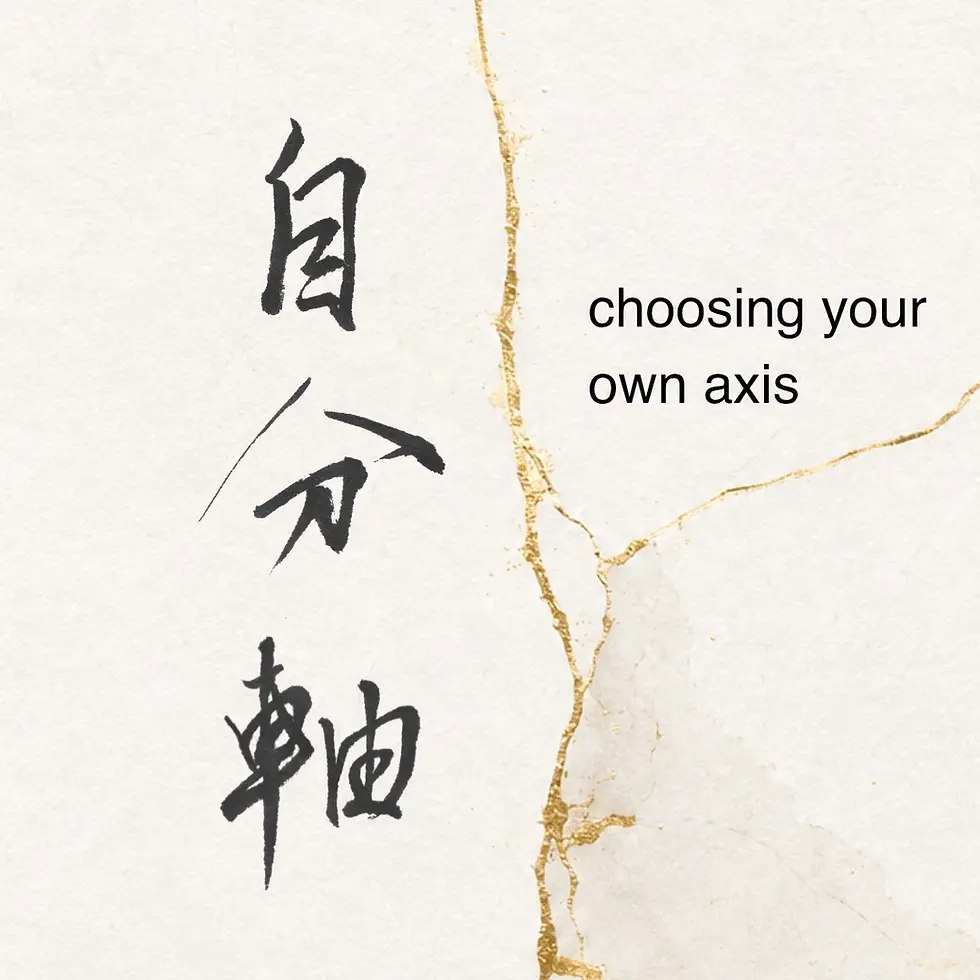
As a calligrapher, I often think about this while working.
When I write, I am not only placing ink on paper.
I am also deciding where not to write.
The untouched space matters just as much as the stroke itself.
Perhaps life works similarly.
Not every silence must be filled.
Not every opinion requires reaction.
Not every surface needs another wave.
Sometimes, depth begins when the turbulence finally settles.